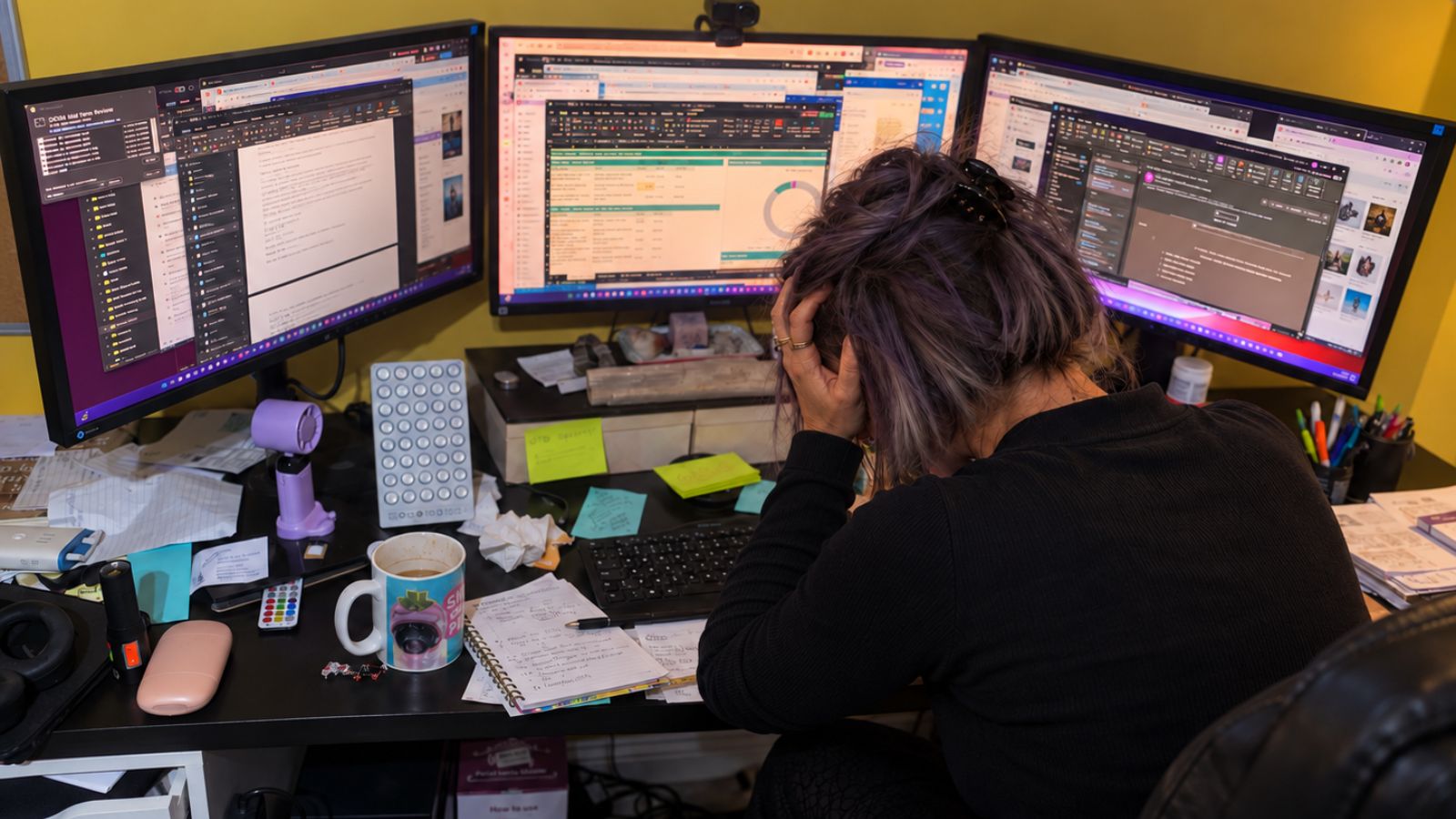
You know you have an ADHD-wired brain when you sit down to watch Netflix and an hour and a half later you pause the TV, only to realise you’re nine minutes into the programme.
That was me.
I sat there wondering what the hell had happened, forgetting this was probably the umpteenth time I’d paused it, wandered off to do something else, and then come back and pressed play again. I’d watch for a couple of minutes, remember something I needed upstairs, get up to do that, notice something else while I was there, come back down, pick up my phone, put something away, make a drink, remember another thing…
Meanwhile, Netflix was patiently waiting for me to get my shit together.
If I’d checked my WHOOP afterwards, I imagine the step count would have told the story. Up and down the stairs, getting things, forgetting things, stopping, starting. My brain continually jumping onto whatever suddenly felt more important, more interesting or more urgent right now.
It’s funny when it’s Netflix. It’s less funny when you look back and realise how much of your life has followed a similar pattern.
I was diagnosed with ADHD just before my 47th birthday. Dyslexia had only been picked up a few years earlier, halfway through doing my MSc.
That still makes me laugh in a slightly despairing way. I’d dropped out of school with no qualifications, then in my thirties managed to do an access course, go on to get a degree, and make it halfway through a master’s before discovering that one of the reasons I’d spent so much of my earlier education struggling was that my brain actually processed things differently.
School had been a disaster in many ways. I failed things. I had almost no interest in most of what we were supposed to be learning, and there seemed to be this narrative that I was just lazy, didn’t apply myself, was distracted or simply wasn’t very bright.
Yet I would go to the library and voluntarily take books out about the Chernobyl disaster. At another point I became fascinated by Marie Antoinette and the French Revolution. Why? No idea. Even now those particular subjects seem fairly random.
But something about them grabbed my brain, and when that happened I could become completely absorbed. The strange thing was never that I couldn’t learn. I clearly could. It was that I seemed to have very little control over what my brain decided was worthy of that level of attention.
Looking back now, there are hundreds of little clues like that.
For me, ADHD has also meant having a very strong relationship with the now. Something in front of me can feel enormous while something six months away can barely feel real at all. Long-term consequences have often struggled to compete with whatever is exciting, rewarding or happening right in front of me.
When I was younger, drugs were very good at giving me that.
I wasn’t sitting there at 18 carefully contemplating where my choices might take me at 25, 30 or 40. I wanted what was happening now. Drugs were exciting, social and intense, and I can see now how well that fitted the way my brain worked.
That doesn’t remove responsibility for the choices I made, and I don’t want it to. Understanding why something happened isn’t the same as excusing it.
For years, I only had the consequences to look at. School failures. Fourteen years of drug abuse. Chaotic decisions. Starting things and not finishing them. Periods where I could work with almost frightening intensity, followed by times when doing something incredibly basic felt ridiculously difficult.
I was constantly wondering why I could be so capable in some areas and completely unable to hold things together in others. And underneath all of that was what it did to the way I saw myself.
Because when you don’t know there is another explanation, you make one up from what you can see. Maybe I was lazy. Maybe I was unreliable. Maybe I was just useless at things other people seemed able to get on with. Why did I keep fucking things up? How could I do something incredibly difficult and then fail miserably at something that looked so basic?
After enough years of that, it becomes part of how you see yourself.
This is one of the reasons I struggle when people roll their eyes at ADHD diagnoses or say everyone ‘has a bit of ADHD these days’. I understand some of the scepticism. We all get distracted. We all procrastinate. Let’s face it, our phones are vying for our attention from the moment we get up. I was brought up in a time before that though.
And I’m not talking about just struggling to focus when doing seemingly boring tasks.
I’m talking about something that ran through decades of my life before I even knew what I was looking at. It wasn’t just a few annoying habits or being a bit scatty. It affected my education, contributed to a turbulent career path and repeated cycles of overspending and debt, and showed up in my relationships through emotional dysregulation and severe rejection sensitivity. I took dangerous risks because I couldn’t see the longer-term consequences, and then there’s the self-esteem I’ve spent a lifetime trying to pick up off the floor.
Getting diagnosed didn’t magically repair any of that. It didn’t rewrite the past, give me back the years I spent struggling or suddenly make everyday life effortless.
What it did was give me a different way of looking at myself. There was finally an explanation for some of it.
I could start noticing how my brain worked rather than endlessly trying to force it to behave like somebody else’s. I could look back at that child who appeared completely uninterested at school but happily went home and read about Chernobyl and see something other than failure.
That was a relief. It didn’t absolve me of anything, and it wasn’t an excuse. It was simply a missing piece of information about the person I’d been trying to understand for nearly 47 years.